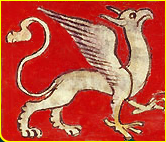
Cecco d’Ascoli
Biography
Cecco d'Ascoli (1257 – September 26, 1327) is the popular name of Francesco degli Stabili (sometimes given as Francesco degli Stabili Cichus), an Italian encyclopaedist, physician and poet. He devoted himself to the study of mathematics and astrology. In 1322 he was made professor of astrology at the University of Bologna. Having published a commentary on the Sphere of John de Sacrobosco, in which he put forth possibly heretical theories concerning the employment and agency of demons, he got into difficulties with the Church, and was condemned in 1324 to fasts and prayers, and to the payment of a fine. To avoid further trouble he moved to Florence. His freethinking and plain speaking had made him many enemies; he had attacked the Commedia of Dante and the Canzone d'amore of Guido Cavalcanti. He was burned at the stake for heresy.
The Acerba
The book by which he achieved his fame was the Acerba (from the Latin acervus, "bitter"), an encyclopedic poem. It is also known as Acerba etas, Liber acerbe etati, Liber Acerbae Aetatis and other similar variations.
It is a treatise on the natural science of his time, including the order and influences of the heavens, the characteristics and properties of animals and precious stones, the causes of phenomena such as meteors and earthquakes, and of commonplace moral philosophy.
L'Acerba is presented in five books, with the fifth book unfinished.
- Book 1: The heavens and their properties
- Book 2: Fortune, astrology, the formation of humans, the virtues and emotions
- Book 3: Animals, birds and serpents; lapidary
- Book 4: Answers to questions on many topics
- Book 5: Faith (incomplete)
Manuscripts and Editions
Despite being banned by the church, the work continued to be popular, and at least 26 manuscripts still exist, dating from the 14th and 15th centuries. See the Manuscripts tab above for a list. (There are several others not listed here that include part of the text, but not Book 3 on animals. There are also some listed by Rosario that have not been verified or located.)
There are three illustrated manuscripts.
- Archivio storico civico e Biblioteca trivulziana, Triv.1020 (15th century)
- Biblioteca Medicea Laurenziana, Plut.40.52 (14th century)
- Bodleian Library, MS. Canon. Ital. 38 (15th century)
By 1546 more than twenty printed editions had been issued.
- Cecco d'Ascoli, L'Acerba (1476, Venezia)
- Cecco d'Ascoli, L'Acerba )1484, Venezia
- Cecco d'Ascoli, L'Acerba (1492, Venice)
The primary modern Italian editions of the Acerba are Pasquale Rosario, L'Acerba etas (1916) and Marco Albertazzi, L'Acerba (2002). The only English translation is Diane Murphy, The Bitter Age (2015).
Animals
The animal chapters describe an animal, then provide an allegory or moralization based on that animal. The animal descriptions are similar to those found in bestiaries, the Physiologus, and medieval encyclopedias. The chapters are usually short, with most being less than 40 lines.
This list of the birds, fish, serpents and animals is based on manuscript Biblioteca Medicea Laurenziana, Plut.40.52 and the Rosario edition.
- [Love]
- Fenice (Phoenix)
- Aquila (Eagle)
- Lumerpa (Hercinia)
- Stellino (unknown bird)
- Pellicano (Pelican)
- Animals and the four elements
- Salamandra (Salamander)
- Camaleone (Chameleon)
- Alech (Fish)
- Talpa (Mole)
- Plombino (Dove)
- Struzzo (Ostrich)
- Cigno (Swan)
- Cicogna (Stork)
- Cicale (Cicada)
- Nocticora (Owl)
- Perdice (Partridge)
- Rondene (Swallow)
- Upupa (Hoopoe)
- Calandrello (Caladrius)
- Voltore (Vulture)
- Erodio/Falcone (Falcon)
- Grifo (Griffin)
- Paone (Peacock)
- Grue (Crane)
- Tortora (Turtledove)
- Corvo (Crow)
- Serena (Siren)
- Gronco (Crab)
- Orospo/Rospo (Frog)
- Ostrega (pearl-oyster)
- Delfin/Dalfino (Dolphin)
- Basalisco (Basilisk)
- Aspido (Asp)
- Draco (Dragon)
- Vipera (Viper)
- Cocodrillo (Crocodile)
- Scorpione (Scorpion)
- Botrace/Boto (Frog/Toad)
- Aranea (Spider)
- Leone (Lion)
- Elefante (Elephant)
- Liopardo (Leopard)
- Yema/Hiema (Hyena)
- Pantera (Panther)
- Tigro (Tiger)
- Castoreo (Beaver)
- Unicorno (Unicorn)
- Symia (Ape)
- Cervo (Stag)